Why HIPAA Compliance and Cloud-Based LLMs Are a Risky Mix
PrivateDocsAI Team
The healthcare and legal sectors are currently caught in a high-stakes tug-of-war. On one side, the transformative power of Generative AI promises to automate document review, summarize patient records, and streamline billing. On the other side stands the Health Insurance Portability and Accountability Act (HIPAA), a regulation that demands absolute control over Protected Health Information (PHI).
As we navigate 2026, many organizations have realized that "checking the box" on a cloud provider’s Business Associate Agreement (BAA) is not the same as achieving true data sovereignty. While cloud-based Large Language Models (LLMs) offer convenience, they introduce a level of third-party risk that is inherently at odds with a Zero-Trust AI strategy.
For medical malpractice firms, healthcare providers, and insurers, the search for a ChatGPT enterprise alternative for law firms and medical executives has led to a pivot toward offline enterprise AI. To truly protect PHI, the AI must come to the data—not the other way around.
The Cloud-HIPAA Friction: Where the Risks Hide
Most cloud-based AI tools operate on a "Data-to-AI" model. This means your sensitive documents—containing names, Social Security numbers, and medical histories—are transmitted over the internet to be processed on a remote server. Even with encryption, this journey exposes several critical friction points for HIPAA compliance:
- The "Data-in-Use" Exposure: Encryption protects data while it is sitting on a drive or moving through a pipe. However, to process a prompt, the cloud server must decrypt the data. During this window, your PHI is in a "raw" state in a memory environment you do not own.
- The Metadata Leak: Even if the contents of a query are secured, the metadata—who is querying what, when, and from where—can often be reconstructed by sophisticated actors or accidentally leaked in debug logs.
- The BAA Limitation: A BAA is a legal document, not a technical firewall. It mitigates liability after a breach occurs, but it does not prevent the breach from happening.
For these reasons, data privacy AI tools that function entirely offline are becoming the new standard for HIPAA-regulated environments.
Pillar 1: Reclaiming PHI Sovereignty with Private RAG Architecture
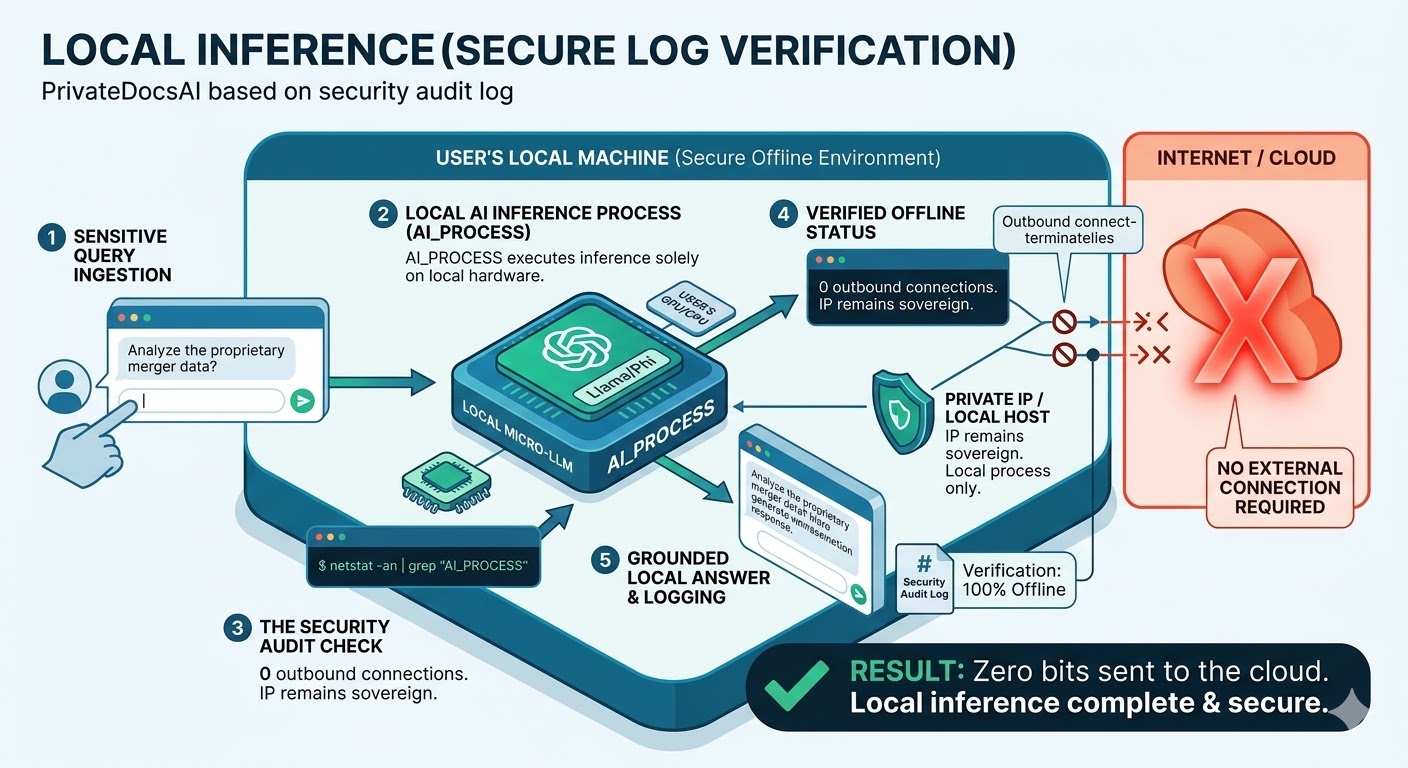
To eliminate the risks of cloud processing, organizations are adopting a Private RAG architecture. This ensures that the Retrieval-Augmented Generation process—the mechanism that allows the AI to "chat" with your documents—stays local.
In PrivateDocsAI, the entire pipeline is self-contained:
- Local Ingestion: Your sensitive PDFs and Word docs stay on your encrypted local drive.
- Local Embedding: The
bge-m3model converts PHI into mathematical vectors on your own CPU/GPU. - Local Vector DB: These vectors are stored in
ChromaDBlocally, ensuring that the "knowledge base" of your patient files never touches a public API.
Pillar 2: Micro-LLMs and the Efficiency of Local AI Performance
A common misconception is that local models are "weaker" than cloud models. In reality, Local LLMs for business have evolved to be highly specialized. For tasks like extracting billing codes from an invoice or summarizing a medical deposition, Micro-LLMs like Qwen or Phi often match the performance of trillion-parameter cloud models without the astronomical costs or security trade-offs.
PrivateDocsAI is hardware agnostic, meaning it can run on everything from a standard business laptop to a high-end workstation. It auto-scales its performance to ensure that even the most dense medical records can be parsed instantly and offline.
Pillar 3: Smart Table Parsing and OCR for Medical Records
Medical and legal documents are notoriously "messy." They are filled with complex tables, scanned invoices, and structured data that traditional AI often fails to read.
PrivateDocsAI solves this with Smart Table Parsing and advanced local OCR. This allows a financial analyst or a lawyer to:
- Drag a 500-page medical billing folder into the application.
- Use the local AI to extract specific line items without cloud intervention.
- Chat with the tables directly to find discrepancies.
Because the OCR is local, no images of PHI are ever uploaded to an external server for processing—a common "hidden" leak in many cloud-based secure document AI tools.
Strict Grounding: Preventing "Medical Hallucinations"
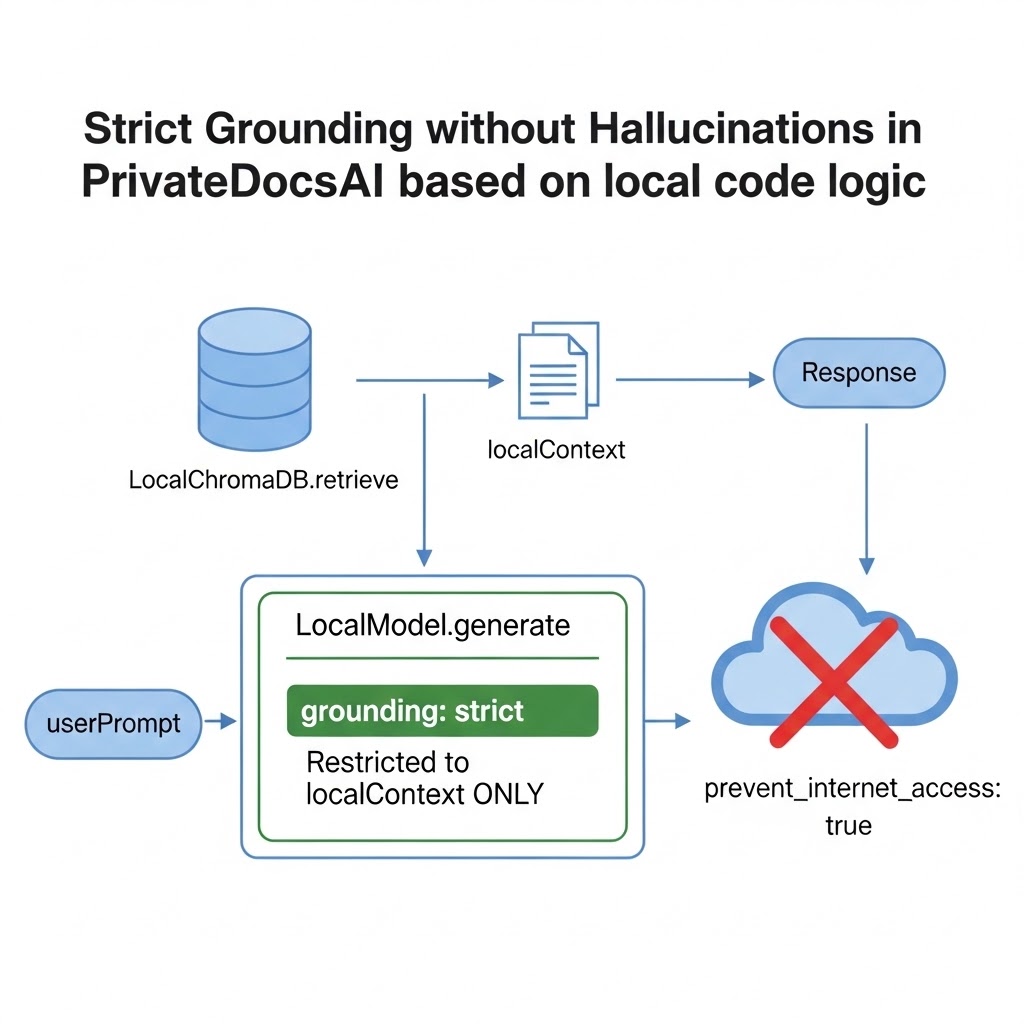
In a healthcare or legal context, a "hallucination" isn't just a technical error—it's a liability. If an AI makes up a medical fact or a legal precedent, the consequences can be devastating.
PrivateDocsAI implements Strict Grounding. The AI is hardcoded to answer queries only using the documents provided in the local vault. If the answer isn't in the file, the AI won't guess. This technical transparency ensures that your summaries and extractions are always anchored in the source material.
The ROI of Local-Only B2B AI
Beyond the security benefits, shifting to offline enterprise AI offers a clear financial advantage:
- Zero API Fees: No more per-token billing or cloud "seat taxes" that make AI costs unpredictable.
- Productivity Gains: Instant Document Chat means no more time wasted waiting for uploads or cloud processing.
- Audit Readiness: When the auditor asks where the data goes, your answer is simple: "It never leaves our hardware."
Conclusion: Data Sovereignty is the Only Real HIPAA Security
As we look at the landscape of 2026, it is clear that the cloud is a "leaky bucket" for high-stakes data like PHI. For organizations that cannot afford a single breach, the only solution is to rethink the perimeter.
By implementing a Zero-Trust AI strategy with PrivateDocsAI, you can provide your lawyers, analysts, and executives with the world-class power of generative AI while ensuring that your compliance posture remains unshakeable. It is time to bring the AI to the data and reclaim your sovereignty.
Next steps
Ready to test a truly private AI? Download the PrivateDocs AI desktop app today and start your free 7-day trial. Experience local RAG on your own hardware—no credit card required. Your documents and chat queries stay on your device; brief connections are used for sign-in, licensing, and billing.