SOC2 Audit Survival Guide: Managing AI Data Sovereignty
PrivateDocsAI Team
In 2026, the artificial intelligence landscape has shifted from "exploration" to "total integration." For law firms, financial institutions, and healthcare providers, this integration brings a formidable challenge: the SOC2 audit. As auditors sharpen their focus on how generative AI handles sensitive data, the traditional cloud-based AI model is becoming a significant liability.
The core of a successful SOC2 Type II audit in the AI era is proving Data Sovereignty. It is no longer enough to have a "Privacy Policy" from a cloud vendor. You must demonstrate that your data is handled within a Zero-Trust AI strategy.
To achieve this, many organizations are moving away from public APIs and adopting a local ChatGPT enterprise alternative for law firms and highly regulated sectors. In this guide, we will break down how to build a zero-trust AI architecture that doesn't just pass audits but sets a new standard for corporate security.
The Zero-Trust AI Framework: "Never Trust, Always Verify"
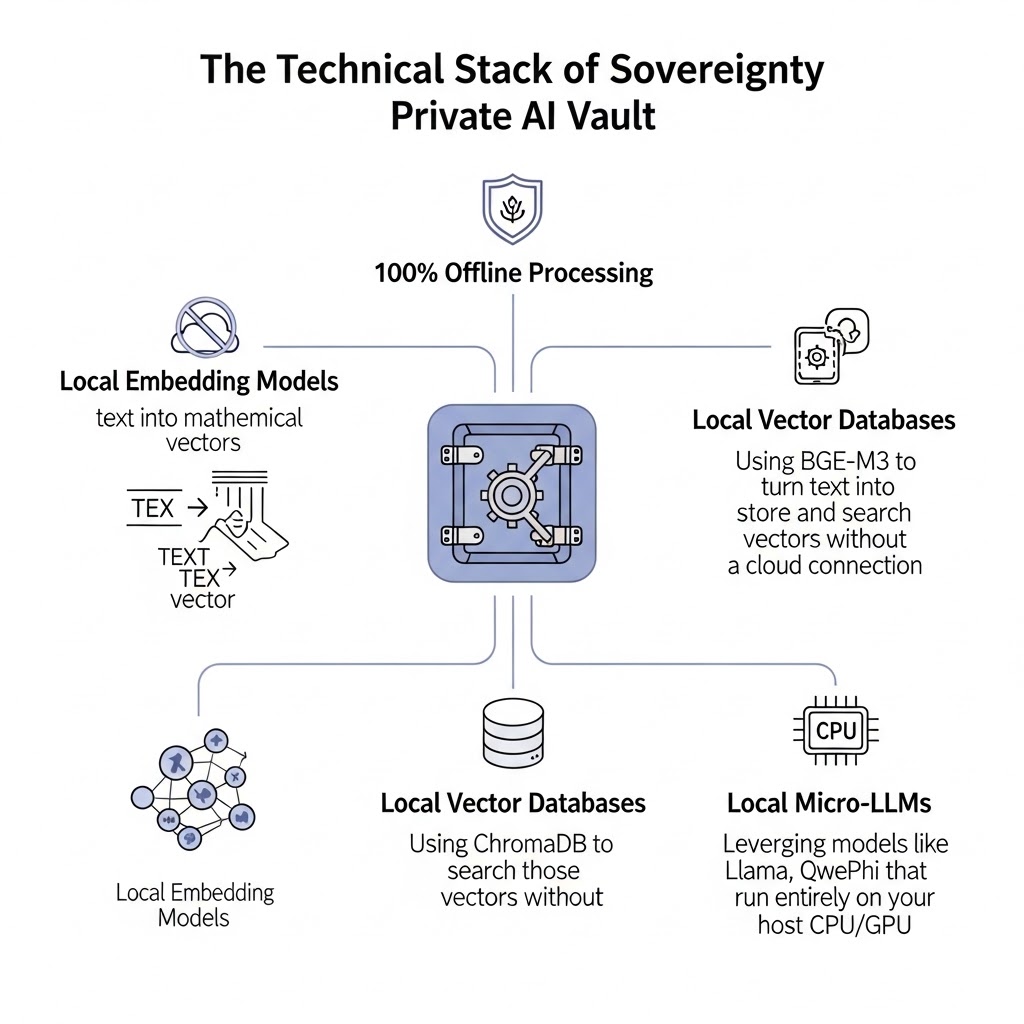
Traditional security models focused on the perimeter—keeping the bad actors out. However, cloud-based AI requires you to push your most sensitive data out to a third party. Under a Zero-Trust framework, this is a fundamental failure.
A true Zero-Trust AI strategy is built on three pillars:
- Verifiable Data Residency: Knowing exactly where every byte of data lives.
- Local Inference: Processing data on-device to eliminate transit risks.
- Strict Grounding: Ensuring the AI cannot access the public internet or "hallucinate" beyond your approved dataset.
Why the Cloud is a SOC2 Risk
When you use a cloud-based AI tool, your data is in transit, being processed in memory on a remote server, and potentially stored in logs for "safety monitoring." From a SOC2 perspective, this expands your "Trust Services Criteria" scope to include the AI vendor's entire infrastructure. By switching to a local LLM for business, you bring that scope back under your direct control.
Implementing Private RAG Architecture
The key to utility in enterprise AI is Retrieval-Augmented Generation (RAG). This is what allows your AI to "chat" with your private documents. However, to maintain data sovereignty, you need a Private RAG architecture.
In PrivateDocsAI, the RAG process is entirely self-contained on the host's hardware.
By keeping this entire pipeline on the desktop, you eliminate the need for Third-Party Data Processing Agreements (DPAs) and simplify your compliance map.
Smart Table Parsing and OCR: The Compliance Advantage
Law firms and financial analysts deal with a specific type of "messy" data: scanned PDFs, complex invoices, and multi-page tables. Most AI tools require "OCR-as-a-service," which involves sending images of these documents to a cloud API for text extraction.
For a CISO, this is a nightmare. Every scanned invoice sent to the cloud is a potential leak of PII or trade secrets.
PrivateDocsAI solves this with Smart Table Parsing. Our advanced OCR runs locally on your workstation. It can ingest a 500-page deposition or a complex quarterly tax filing and structure that data for the AI without a single packet leaving the building.
Case Study: Due Diligence in a Zero-Trust Environment
Imagine an M&A team reviewing thousands of confidential contracts. In a cloud-based setup, the risk of a breach during this high-stakes period is immense. With a secure document AI like PrivateDocsAI, the team can search for "change of control" clauses across 10,000 pages of local data instantly, with 100% certainty that the data remains sovereign.
From "Shadow AI" to Secure Innovation
One of the biggest pain points highlighted in modern SOC2 audits is "Shadow AI"—employees using personal ChatGPT accounts to summarize corporate data.
To stop this, you cannot simply ban AI; you must provide a superior, secure alternative. PrivateDocsAI serves as a ChatGPT enterprise alternative that actually wins over users because:
- It’s Faster: Local inference on high-end workstations often beats cloud latency.
- It’s Hardware Agnostic: It runs on a standard business laptop or a high-end Mac Studio.
- It’s Grounded: The AI provides citations back to the local source document, eliminating the "hallucination" risk that plagues public models.
Building Your 2026 AI Roadmap
If you are an IT Director or CISO, your 2026 roadmap should prioritize offline enterprise AI. Here is how to transition your firm to a Zero-Trust AI model:
1. Identify "High-Sovereignty" Data
Determine which departments handle data that can never be uploaded (Legal, HR, Finance). These departments should be the first to transition to PrivateDocsAI.
2. Audit Your Hardware
Since PrivateDocsAI is hardware agnostic, you don't need a million-dollar server room. Most modern business laptops with 16GB+ of RAM can handle local Micro-LLMs like Qwen or Phi for document chat.
3. Deploy and Monitor
Deploy the PrivateDocsAI desktop application. Because it’s an offline enterprise AI, you can monitor the application logs locally to ensure no unauthorized network calls are being attempted.
The ROI of Data Sovereignty
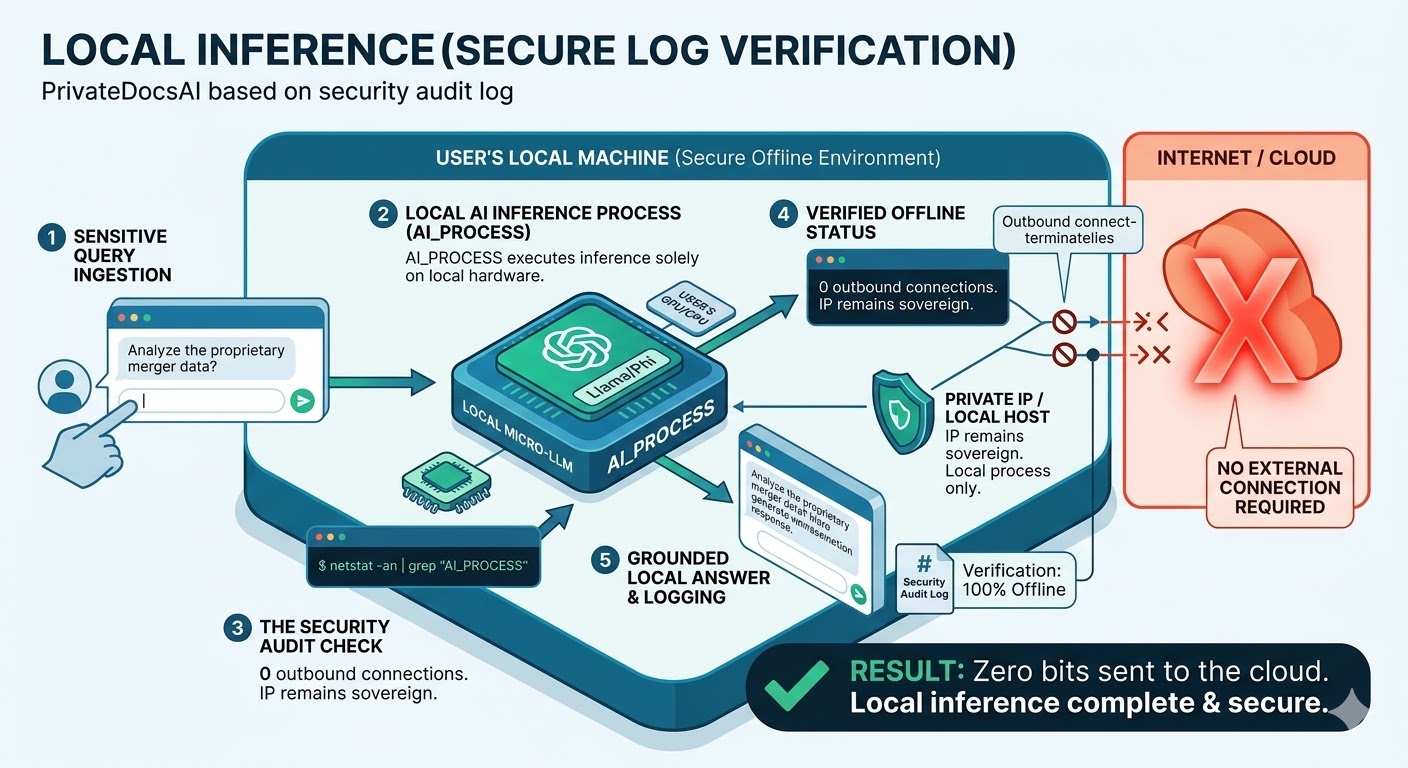
Investing in a local AI strategy isn't just about security; it's about the bottom line.
- Eliminate API Costs: No more "pay-per-token" fees that make cloud AI unpredictable.
- Reduce Insurance Risk: Cyber-insurance providers in 2026 are heavily penalizing firms that don't have a clear AI data policy.
- Client Trust: For law firms, being able to tell a client that document AI processing stays on your hardware (not uploaded to a cloud LLM for inference) is a powerful competitive advantage.
Conclusion
The era of trusting the cloud with your most sensitive intellectual property is ending. As SOC2 audits become more rigorous regarding AI data sovereignty, the shift toward local, secure document AI is inevitable.
By building a Zero-Trust AI strategy today using PrivateDocsAI, you aren't just protecting your data—you're future-proofing your business.
Next steps
Ready to test a truly private AI? Download the PrivateDocs AI desktop app today and start your free 7-day trial. Experience local RAG on your own hardware—no credit card required. Your documents and chat queries stay on your device; brief connections are used for sign-in, licensing, and billing.