GDPR vs. GenAI: Can You Actually Be Compliant Using Cloud LLMs?
PrivateDocsAI Team
As Generative AI moves from a "nice-to-have" novelty to a core operational requirement, law firms and enterprise legal departments are hitting a regulatory wall. On one side, there is the undeniable efficiency of Large Language Models (LLMs). On the other, there is the General Data Protection Regulation (GDPR)—the world’s most stringent data privacy law.
The central question facing CISOs and Partners today is: Can a law firm truly remain GDPR compliant while sending privileged client data to a cloud-based AI?
Despite the marketing promises of "Enterprise Grade" cloud solutions, the technical reality of how cloud LLMs process data creates several high-risk friction points with EU data protection standards. To mitigate these risks, firms are increasingly turning to a ChatGPT enterprise alternative for law firms that operates entirely within their own local perimeter.
The Fundamental Friction: Cloud AI vs. GDPR
The GDPR is built on the principles of data minimization, purpose limitation, and storage limitation. Cloud-based AI models, by their very nature, tend to challenge these principles.
1. The Data Transfer Dilemma
Under GDPR, transferring Personal Identifiable Information (PII) to "third countries" (specifically the US, where most AI giants are headquartered) requires rigorous Data Transfer Impact Assessments (DTIAs). Even with standard contractual clauses, the risk of foreign government surveillance on cloud servers remains a point of contention for EU regulators.
2. The Right to Erasure (Right to be Forgotten)
GDPR Article 17 gives individuals the right to have their data deleted. In a traditional database, this is simple. In an AI context—where data is vectorized, cached for debugging, or potentially used for fine-tuning—guaranteeing the total "erasure" of a specific data point from a third-party cloud provider's ecosystem is a technical and legal minefield.
3. Data Sovereignty and Control
Law firms act as "Data Controllers." When you upload a client's case file to a cloud-based secure document AI, the AI provider becomes a "Data Processor." If that processor suffers a breach, or if their sub-processors (cloud infrastructure providers) are compromised, the Law Firm is still legally and reputationally liable.
Why "Opt-Out" Policies Aren't Enough for Law Firms
Many cloud AI vendors offer "Enterprise" tiers where you can opt-out of having your data used to train their models. While this is a step in the right direction, it does not address the Security of Processing (GDPR Article 32).
Even with an opt-out, your data still leaves your hardware. It travels over the public internet, is decrypted on a remote server, and resides in a cloud environment you do not control. For lawyers handling sensitive PII in litigation, this "transit and processing" window is a massive liability.
This is why PrivateDocsAI was designed with a Zero-Trust architecture. By ensuring that enterprise-grade AI never leaves your hardware, we eliminate the "third-party processor" risk entirely.
The Solution: Private RAG Architecture and Local LLMs
To achieve 100% compliance, the AI must come to the data. This is achieved through Private RAG (Retrieval-Augmented Generation).
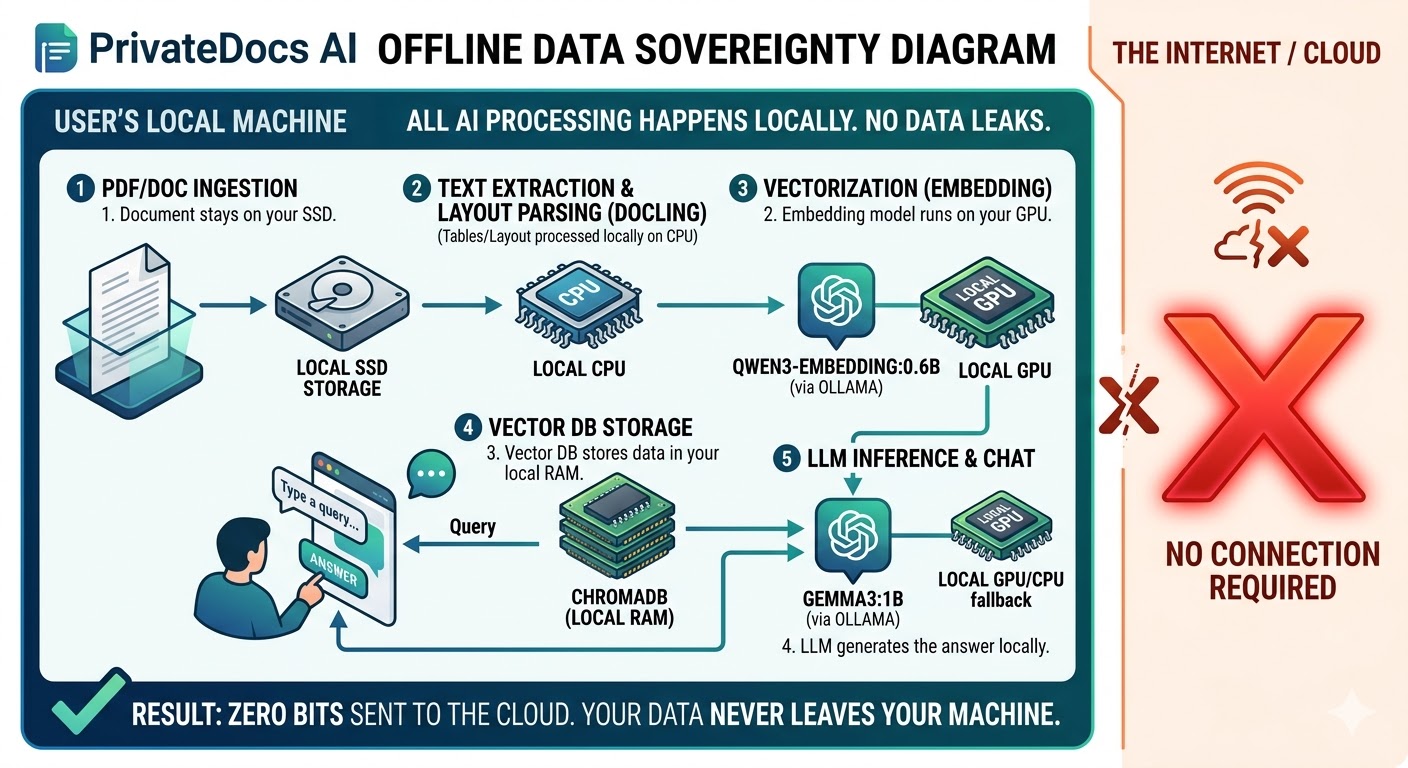
In a Private RAG architecture, the entire AI stack—the LLM, the vector database, and the embedding model—runs on your host machine.
How PrivateDocsAI Solves the GDPR Equation:
- Local AI processing: For vault workloads, document content is not sent to a cloud LLM API—reducing cross-border transfer risk for that AI path. (Account and billing traffic is separate and disclosed in our Privacy Policy.)
- Total Data Sovereignty: Your firm remains the sole custodian of the data.
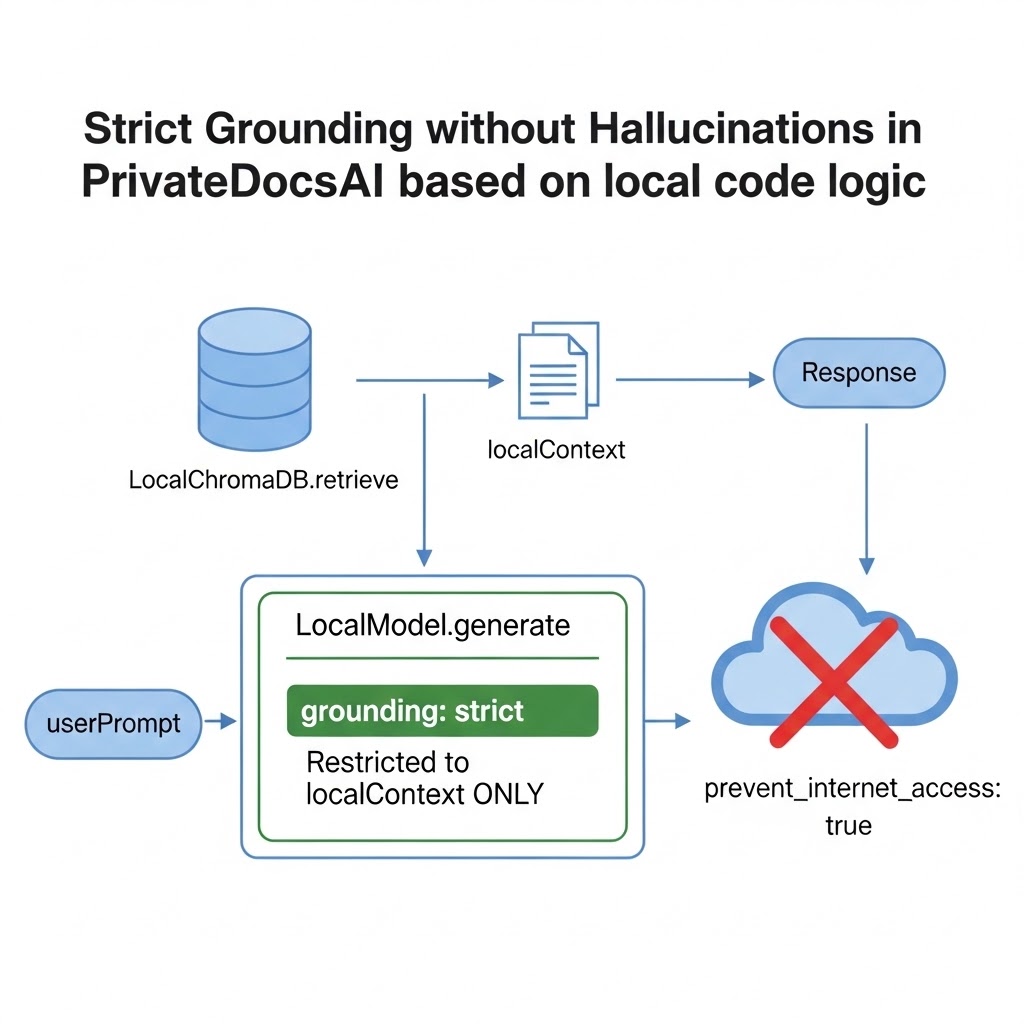
- Strict Grounding: The AI is hardcoded to answer using only your uploaded documents. This ensures that the output is verifiable and compliant with the original intent of the document ingestion.
Smart Table Parsing: Handling Sensitive Financial PII
GDPR is particularly sensitive regarding financial data. Law firms often deal with dense, complex invoices and financial statements in PDF format. Extracting this data using public AI tools risks exposing bank account numbers, tax IDs, and transaction histories to the cloud.
PrivateDocsAI features Smart Table Parsing and advanced local OCR. This allows legal analysts to query complex financial tables locally:
- Ingest: Drag and drop a folder of 1,000 invoices into the application.
- Process: Local
bge-m3models create embeddings on your GPU/CPU. - Query: Ask, "Show all transactions over €10,000 from the February statement."
- Security: The AI extracts the data from the table and provides a grounded answer without a single bit of data reaching the internet.
The ROI of Local AI for Legal Compliance
Beyond the obvious benefit of avoiding GDPR fines (which can reach 4% of annual global turnover), there is a significant ROI in switching to offline enterprise AI.
- Zero API Costs: Cloud AI models charge per token. For law firms processing thousands of pages of discovery, these costs can become unpredictable. A local-only subscription model provides a fixed, manageable cost.
- Reduced Insurance Premiums: Demonstrating that your AI strategy keeps sensitive document processing local and zero-trust can help lower cyber-liability insurance premiums.
- Speed: Local inference on modern workstations often beats cloud API latency, especially when handling massive document sets.
Why Hardware Agnosticism is Key for IT Directors
A major pain point for IT Directors is the cost of upgrading hardware to support AI. PrivateDocsAI is hardware agnostic. It auto-scales its performance based on the machine it’s on—meaning it can run effectively on a partner’s standard business laptop or a dedicated high-end workstation in the IT closet.
This flexibility allows law firms to deploy a local LLM for business across the entire organization without a massive upfront capital expenditure on specialized servers.
Conclusion: Reclaiming the Legal Perimeter
In the race to adopt AI, don't let your firm's compliance posture become an afterthought. The "free" or "cloud-enterprise" options may seem easier to deploy, but the long-term risk of GDPR non-compliance and data leaks is a price no law firm should be willing to pay.
By choosing a secure document AI like PrivateDocsAI, you provide your lawyers, financial analysts, and HR executives with the power of generative AI while keeping your data—and your firm—entirely within your control.
Data sovereignty is no longer a luxury; it is the new standard for the legal industry.
Next steps
Ready to test a truly private AI? Download the PrivateDocs AI desktop app today and start your free 7-day trial. Experience local RAG on your own hardware—no credit card required. Your documents and chat queries stay on your device; brief connections are used for sign-in, licensing, and billing.